Friday, June 3, 2011
Some Peace of Mind
Curtis Mayfield was born on June 3rd, 1942. He rose to prominence with his group, the Impressions, performing some of the classic hits of Soul music. This music became the "soundtrack" to the Black Pride movement in of the late '60s and the Civil Rights Movement as a whole. In the early '70s, he went solo and became associated with the "Blaxploitation" sound and early Funk.
I'm fond of Funk music, but most of it is exceedingly shallow. That's not the case with Mayfield's music. His music expresses a deep empathy for the plight of the disadvantaged. There is an uplifting social consciousness in his lyrics. This is especially notable when the music is contrasted with other music of the "Blaxploitation" style. Most are praises of destructive machismo and glorification of the violent drug-fueled culture of the protagonists. Mayfield's music captures the same urban vibe, but carries a critical message embedded within the funkiness.
It is this softly sung criticism, delivered in a gentle falsetto, that makes his music so enduring.
Window Flowers for Friday
Wind and Window Flower
(By Robert Frost)
LOVERS, forget your love,
And list to the love of these,
She a window flower,
And he a winter breeze.
When the frosty window veil
Was melted down at noon,
And the cagèd yellow bird
Hung over her in tune,
He marked her through the pane,
He could not help but mark,
And only passed her by,
To come again at dark.
He was a winter wind,
Concerned with ice and snow,
Dead weeds and unmated birds,
And little of love could know.
But he sighed upon the sill,
He gave the sash a shake,
As witness all within
Who lay that night awake.
Perchance he half prevailed
To win her for the flight
From the firelit looking-glass
And warm stove-window light.
But the flower leaned aside
And thought of naught to say,
And morning found the breeze
A hundred miles away.
And list to the love of these,
She a window flower,
And he a winter breeze.
When the frosty window veil
Was melted down at noon,
And the cagèd yellow bird
Hung over her in tune,
He marked her through the pane,
He could not help but mark,
And only passed her by,
To come again at dark.
He was a winter wind,
Concerned with ice and snow,
Dead weeds and unmated birds,
And little of love could know.
But he sighed upon the sill,
He gave the sash a shake,
As witness all within
Who lay that night awake.
Perchance he half prevailed
To win her for the flight
From the firelit looking-glass
And warm stove-window light.
But the flower leaned aside
And thought of naught to say,
And morning found the breeze
A hundred miles away.
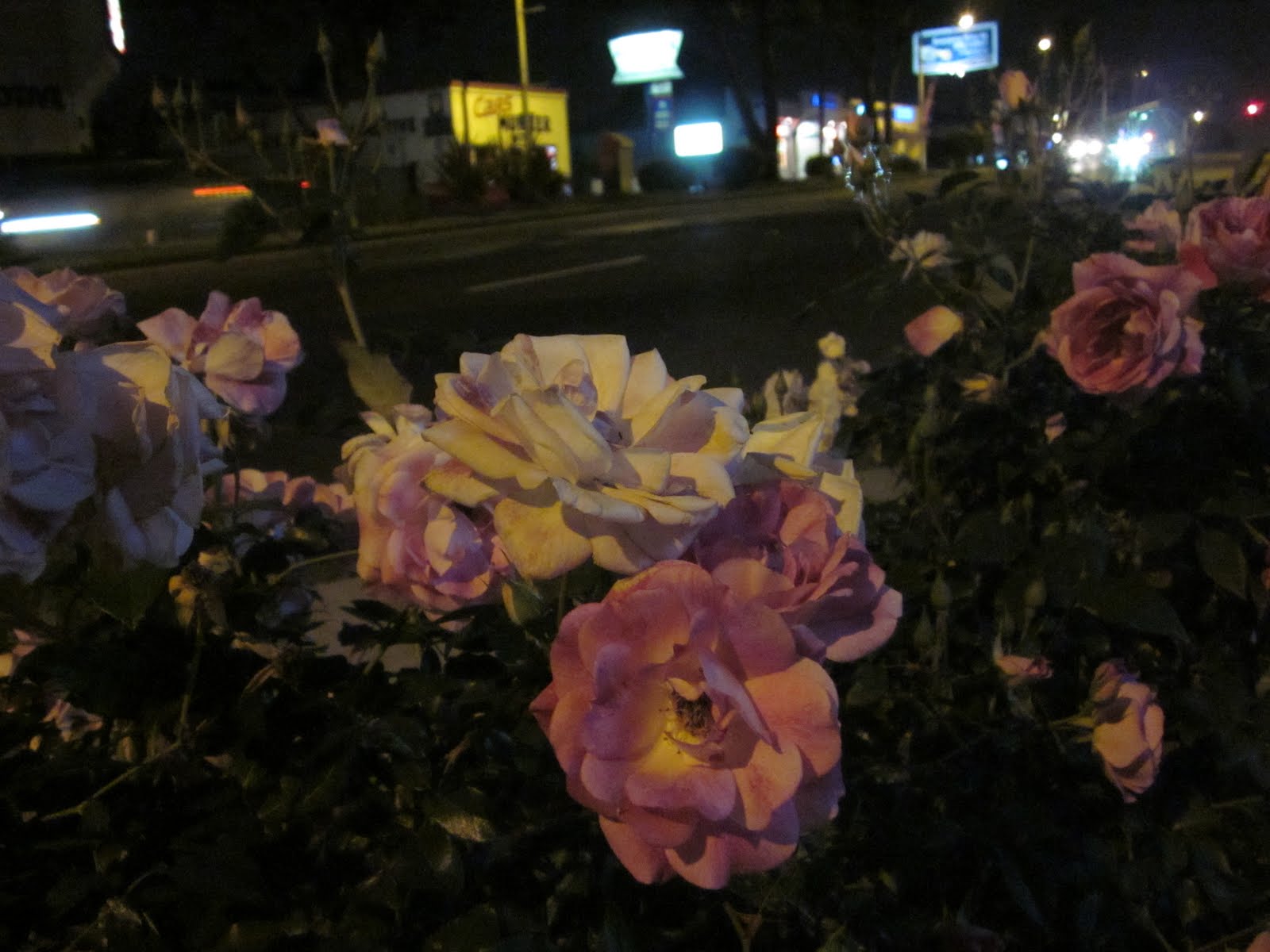
Well, this week has been a bit light on the posting, but that's no reason to skip our Friday flowers. ;-)
Wednesday, June 1, 2011
Sixth Weekly Wrap Up
As predicted, my weekend put my blogging on hiatus. But here's my "Weekly Wrap Up" a few days late ;-)
* * *
Another week has passed. This one was pretty good. My production isn't quite what I'd like, but I'm pretty happy with my post quality. There was a healthy diversity in subject matter. There is plenty of room for improvement, but I've finally hit a baseline degree of competence in my posting style.
The things that really please me about this week are the technical changes. First, I used to have only seven topics on the front page, but I altered the settings so as to allow twelve. I think that's a good amount for the front.
Second, I'm utilizing jumps for all my posts. I think that makes for a cleaner look and keeps a megapost from dominating the page. Moreover, I'm putting the vid links after the jump so as to keep to front page smooth.
So, lets get to the posts:
Sunday, May 29, 2011
Le Sacre du Printemps
| Rite of Spring, Joffrey Ballet |
The ballet, Rite of Spring, premiered on this date in 1913 at the Theatre des Champs-Elysees in Paris. The music was composed by Igor Stravinsky. It is intended to portray an ancient pagan ritual in which a young maiden dances herself to death as a sacrificial offer to the God of Spring. The music and choreography were so unconventional that a small riot broke out during the performance.
Over time, it has become an iconic example of 20th century classical music.
| Desiree Lubowsky, 1924 |
So, let's listen to some "savage" sounds.
Saturday, May 28, 2011
Shaken, Not Stirred
On this date in 1908, Ian Fleming was born. There is much to say about him, but the thing that for which he is most famous is his creation of James Bond, the protagonist of a series of Spy novels. Although the novels were very popular, it was their adaptation to the cinema that made them into pop culture icons.
There is so much that I can write about this topic. In my youth, I was crazy about Spy stories, developed out of my enthusiasm for the James Bond movies and novels. Yeah, there are better, more cohesive novels then Fleming's, but I give him a pass for being a primary inspiration of the genre.
Likewise, the movies can be a bit silly from time to time. But that's part of the Bond charm. ;-)
| Live and Let Die |
In regards to the movies, one of the things that I enjoy the most is the theme music.
Friday, May 27, 2011
Friday's Flowers of the Night
The Night Dances
A smile fell in the grass.
Irretrievable!
And how will your night dances
Lose themselves. In mathematics?
Such pure leaps and spirals ----
Surely they travel
The world forever, I shall not entirely
Sit emptied of beauties, the gift
Of your small breath, the drenched grass
Smell of your sleeps, lilies, lilies.
Their flesh bears no relation.
Cold folds of ego, the calla,
And the tiger, embellishing itself ----
Spots, and a spread of hot petals.
The comets
Have such a space to cross,
Such coldness, forgetfulness.
So your gestures flake off ----
Warm and human, then their pink light
Bleeding and peeling
Through the black amnesias of heaven.
Why am I given
These lamps, these planets
Falling like blessings, like flakes
Six sided, white
On my eyes, my lips, my hair
Touching and melting.
Nowhere.
Irretrievable!
And how will your night dances
Lose themselves. In mathematics?
Such pure leaps and spirals ----
Surely they travel
The world forever, I shall not entirely
Sit emptied of beauties, the gift
Of your small breath, the drenched grass
Smell of your sleeps, lilies, lilies.
Their flesh bears no relation.
Cold folds of ego, the calla,
And the tiger, embellishing itself ----
Spots, and a spread of hot petals.
The comets
Have such a space to cross,
Such coldness, forgetfulness.
So your gestures flake off ----
Warm and human, then their pink light
Bleeding and peeling
Through the black amnesias of heaven.
Why am I given
These lamps, these planets
Falling like blessings, like flakes
Six sided, white
On my eyes, my lips, my hair
Touching and melting.
Nowhere.
Well, we've come to another holiday weekend. That means my posting will be fairly scarce over the next few days. But I might find time to do quick "link" posts to keep all you all entertained and informed. ;-)
Shadowtime
Wishing a Happy Birthday to Siouxsie Sioux, born on this date in 1957.
Yeah, I have an eclectic taste in music. Although I never got into the Goth scene of the late '80s and early 90s, I enjoyed the music. Certainly, it could get a bit overwrought and angsty to the point of hilarity, but, when the excesses of pathos are avoided, there were some memorable works of music. Now, I wouldn't classify Siouxsie and the Banshees as just a Goth band, because their music has notable post-punk elements that don't fit well with the Gothic aesthetic. It's probably most accurate to label them as "alternative rock".
Whatever you want to call them, Siouxsie and the Banshees were wonderfully experimental. Heck, they even have a song that uses the glockenspiel!!!
So let's get to the music.
Labels:
alternative rock,
batman,
comic books,
gothic,
pop music,
rome
Thursday, May 26, 2011
Children of the Night
| Nosferatu, 1922 |
On this date in 1897, Dracula by Bram Stoker was published. It wasn't the first treatment of the vampire in Gothic literature and it may not be the best of the lot, but it certainly was the most influential. Tales of vampires had existed for countless centuries. Yet, it was this book that drew together the salient elements of the folklore and wove it into a coherent and memorable tale.
I am a hardcore enthusiast of horror fiction, but vampires have never been my thing. I prefer the forlorn haunting of classic ghost stories or the cosmic weirdness of Lovecraftian horror. There has always been a geeky power fantasy underlying the vampire narrative. This has become more prominent in recent years, such as in the writings of Anne Rice or Stephenie Meyer, to choose two from among many.
| Dracula (1931), Bela Lugosi as Dracula and Frances Dade as Lucy |
I know many horror enthusiasts HATE the angsty vamps and sparkly vamps. But I'd argue that these types are but realizations of the unstated attraction that vampires have always had, even back in the earliest Gothic examples.
But should vampires be the "good guys" of the narrative?
Birth of the Cool
On this date in 1926, Miles Davis was born. Without a doubt, Davis was among the most influential of jazz musicians. He was a leading innovator from the post-Swing era to jazz fusion. His creative legacy not only remains a vital force in contemporary jazz, but has spread out to influence the broader musical tradition.
When I first started studying jazz, the music of Miles Davis was my guide. The early history of jazz is easy to follow. You start off with the roots of Ragtime and the blues, then enter into traditional jazz (New Orleans/Chicago style), which transforms into Swing and the Big Band era. Then it wraps up into bebop. After this point, things get a bit complicated. You have a mix of wildly diverse styles and techniques competing with each other.
However, this is the era of Miles Davis. And he explores the entirety of the jazz scene through his music. Just listen to his albums and you can hear the trends and techniques of the day.
So, let's get to the music
Wednesday, May 25, 2011
The Body Never Lies
| Insouciance (2011) by Robert L. Schultz |
The Koplin Del Rio Gallery in Culver City currently has an exhibit of drawings by Robert L. Schultz. Of the 15 works on display, most of them are graphite on paper. And all of them are figure pieces, devoid of color. Yeah, that doesn't sound too exciting, but I really enjoyed the show. These works are exquisitely detailed with subtle gradations of value. This creates a physicality to the figures, with texture, contour, and depth. The images project a compelling material presence.
There really isn't a coherent theme to the show. Three pieces are standard nudes. Three are of luchadores. Four are of a female model. Three are of a male model with short hair. Two are of a male model with notable tattoos. The only commonality to these works is the aforementioned sense of physical authenticity. These figures look like you can reach into the drawing and touch them.
| Woven Rug (2009) by Robert L. Schultz |
But there is more to these drawings than mere material illusionism.
Take My Waking Slow
![]() |
| A Great Wish by Loretta Yang |
Theodore Roethke was born on this date in 1908. His book, The Waking: Poems 1933-1953, won the 1954 Pulitzer Prize for poetry.
The Waking
(by Theodore Roethke)
I wake to sleep, and take my waking slow.
I feel my fate in what I cannot fear.
I learn by going where I have to go.
We think by feeling. What is there to know?
I hear my being dance from ear to ear.
I wake to sleep, and take my waking slow.
Of those so close beside me, which are you?
God bless the Ground! I shall walk softly there,
And learn by going where I have to go.
Light takes the Tree; but who can tell us how?
The lowly worm climbs up a winding stair;
I wake to sleep, and take my waking slow.
Great Nature has another thing to do
To you and me; so take the lively air,
And, lovely, learn by going where to go.
This shaking keeps me steady. I should know.
What falls away is always. And is near.
I wake to sleep, and take my waking slow.
I learn by going where I have to go.
I feel my fate in what I cannot fear.
I learn by going where I have to go.
We think by feeling. What is there to know?
I hear my being dance from ear to ear.
I wake to sleep, and take my waking slow.
Of those so close beside me, which are you?
God bless the Ground! I shall walk softly there,
And learn by going where I have to go.
Light takes the Tree; but who can tell us how?
The lowly worm climbs up a winding stair;
I wake to sleep, and take my waking slow.
Great Nature has another thing to do
To you and me; so take the lively air,
And, lovely, learn by going where to go.
This shaking keeps me steady. I should know.
What falls away is always. And is near.
I wake to sleep, and take my waking slow.
I learn by going where I have to go.
I appreciate the confessional, vulnerable mood of his poetry. Although the delivery of feeling is direct, I'm intrigued by the obscurity of meaning and circumstance. Some confessional poets get really detailed in their autobiographical expressions. Roethke keeps just enough mystery to maintain a broadness of significance and flexibility of situation.
Mono No Aware
![]() |
| Coast Redwood by Elissa Hoxie |
I had the opportunity to attend the Bonsai show at the South Coast Botanic Garden. Although I'm not a gardener myself, I appreciate the artistry of fine gardening. Perhaps the apex of botanical aesthetic design is the bonsai tree. The years of careful cultivation and arrangement that goes into a bonsai is impressive.
The aesthetic rules of bonsai cultivation can be simplified down to Five Basic Rules:
The first rule is miniaturization. The literal meaning of bonsai is "plantings in tray". But this isn't as easy as it sounds. The photo at the top is of a redwood, a tree type that can grow to over 300 feet tall!!! Controlling growth spurts while maintaining plant health is a difficult task.
![]() |
| Olive by Elissa Hoxie |
The second rule is proportion. Although the tree is kept in miniature, all of its elements must be kept at a similar proportion. This includes the leaves!!! Check out the olive tree in the photo above. These trees are noted for having large clusters of small leaves. How can one replicate such an effect while keeping the tree healthy? Well, there is a functional minimal limit to how small you can get the leaves, but the cluster may be thinned out, giving the impression of proportionality. Therefore, although leaf size is disproportional, the overall foliage proportion is maintained. This effect takes a lot of maintenance.
Subscribe to:
Posts (Atom)